
Book an Appointment
Call Us09958011121Sports Injury Recovery: How Arthroscopy Helps You Heal Faster?
If you have ever played a sport with passion—whether professionally or just because the game fuels your soul—you know one truth: an injury is more than physical pain. It pulls you away from the field, the court, the track, the team, and sometimes even a part of your identity. Athletes often say that the hardest part of an injury is not the moment it happens—it’s the weeks and months that follow. The uncertainty. The fear of not getting back to your best. The isolation from training. The questions about what this means for your future. That is why arthroscopy for sports injuries has been such a breakthrough for athletes. Let’s scroll down and learn thoroughly how arthroscopy helps with recovery from sports injuries.
What is Arthroscopy for Sports Injury?
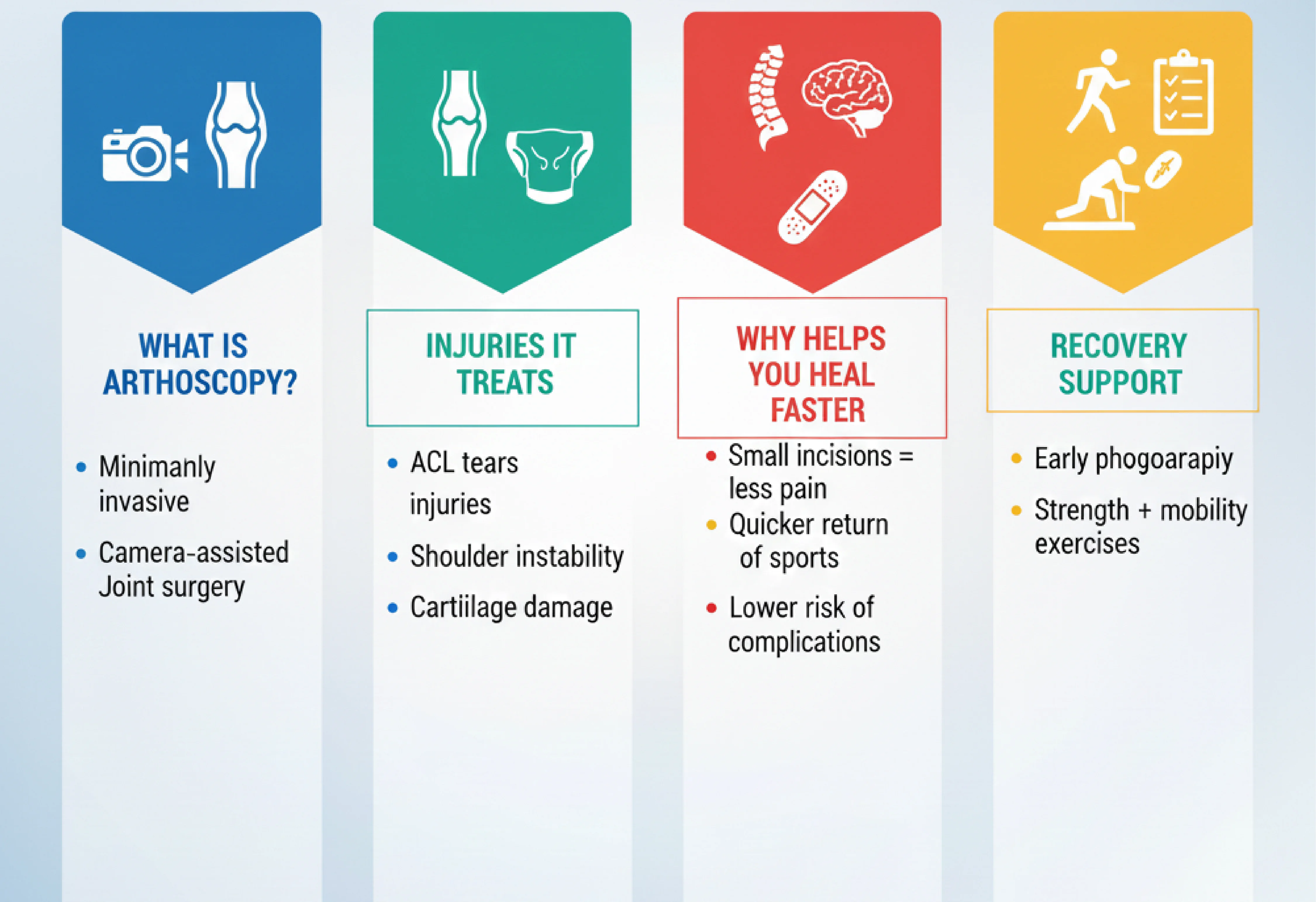
Arthroscopy is an innovative orthopedic procedure that is meant for treating joint issues. In this procedure, a fibre optic camera is used to detect and evaluate the injury. Through a small incision sized as a buttonhole, the surgeon inserts a thin tube connected to a fibre-optic video camera. A high-definition 3D view of the inside of the damaged joint is produced on the video monitor.
Without making a significant incision, arthroscopy enables the surgeon to look inside the damaged joint. Using pencil-thin surgical devices inserted through small cuts, surgeons can even repair joint injury to some extent during arthroscopy for sports injuries.
Read Also: Best Tips for Sports Injury Recovery
Which Sports Injuries Can be Managed With Arthroscopy?
The following are the sports injuries that can be managed with arthroscopy:
- ACL tears: An ACL tear is a rupture of the anterior cruciate ligament (ACL). The ACL is a type of knee ligament. It forms the connection between your femur (thigh bone) and tibia (shin bone). ACL tears are common injuries, particularly among athletes.
- Meniscus tears: A torn meniscus is among the most commonly experienced knee injuries. Any movement that results in severely twisting or rotating your knee, particularly when you put your entire weight on it, might result in a meniscus tear. The meniscus tear induces pain, swelling, and stiffness. You may also experience problems in knee mobility and may struggle to completely extend your knee.
- Rotator cuff tear: A rotator cuff tear is a type of rotator cuff injury that leads to shoulder pain and impairment of arm function. The rotator cuff is a set of muscles and tendons that support and stabilize the shoulder joint. The rotator cuff enables you to lift and move your arms away from your body.
- SLAP and Bankart labral tears: A SLAP (Superior Labrum Anterior to Posterior) tear is a form of labral tear. It affects the uppermost part of the labra ( C-shaped rim of cartilage found in the shoulder joint surrounding the socket) and may involve the attachment site of the biceps tendon, which is present at the top of the shoulder joint. A Bankart tear is a labarum tear that creates a space at the back or front of the socket. This space can become a point of dislocation for the humeral (upper arm bone) head. SLAP and Bankart tears are typically induced by an adverse traumatic hit, such as a fall or accident, or by inappropriate or prolonged use. SLAP tears happen more often in overhead athletes, including volleyball, baseball, and tennis players.
- AC joint arthritis: Arthritis, fractures, and separations are the most common conditions that can affect the acromioclavicular joint, often known as the AC joint. Arthritis is a chronic disease characterized by cartilage loss in the joints. It is basically the wear and tear of the smooth cartilage that permits the bones to move freely. It causes pain and swelling, particularly during physical activity, similar to arthritis in other joints of the body. AC joint arthritis is common among weight lifters.
- AC joint separations: The collarbone no longer aligns with the acromion when the AC joint separates, indicating a tear in the ligaments. Ligaments are tough, sinewy tissues that act as anchors to hold the bones together. Such separation is characterized by deep pain.
- Impingement bursitis: Shoulder impingement is a condition that causes severe discomfort and pain around the shoulder when the arm is elevated to shoulder height or higher. This means that even ordinary actions like combing your hair, reaching for stuff on shelves, driving, or getting ready might cause you pain.
- Shoulder joint fractures: A shoulder fracture occurs when a bone in the shoulder breaks or cracks completely or partially. These fractures usually arise following a fall or a high-impact trauma event. It often leads to severe pain, swelling, and bruises. In such cases, shoulder arthroscopy can help.
- Cartilage damage and ligament tears: Cartilage damage and ligament tears happen when the soft tissues that cushion and stabilize a joint become overstretched, ripped, or worn out as a result of rapid impact, twisting motions, or overuse during sports. These injuries often lead to acute pain, edema, joint instability, and difficulties bearing weight or doing joint movements.
What are the Advantages of Arthroscopy in Sports Injury Management?
The benefits of arthroscopy for sports injuries are countless. The treatment eliminates the need for open surgery and further damage by enabling the joint specialists to examine what is going on inside your joint in a minimally invasive way. The advantages of arthroscopy for sports injuries versus open surgery are:
- Smaller, minimally invasive incisions
- Less traumatic procedure
- Less damaging to the surrounding areas of the joint
- Significantly shorter recovery time
- Less scarring than open surgery
- Less post-surgery pain
Conclusion
Sports injuries are common. However, the majority are minor and heal quite rapidly. The course of injury and recovery may teach us to appreciate our bodies' boundaries as well as their incredible healing capacities. If you're ready to contemplate surgery for your sports injury, the benefits of arthroscopy for sports injuries may make the decision easier. This innovative technique enables surgeons to detect and correct problems in your joint while causing very little tissue invasion.
If an injury impairs your ability to play, you want experts by your side. IBS Hospitals has top sports experts in Delhi who can get you back in the game. For personalized care, book your consultation now!
FAQs
Q1: Is it true that athletes heal faster from surgery than non-athletes?
A: The recovery and rehabilitation in athletes is faster and easier in athletes than non non-athletes because athletes have comparatively stronger joint structures.
Q2: How can I speed up my knee arthroscopy recovery?
A: For a quicker and better recovery, regular exercise is essential right after surgery, usually beginning within 24 hours. During the recovery process, stay away from demanding or high-impact activities that might damage your repaired knee joint.
Q3 What should I anticipate following a sports injury?
A: The nature and severity of a sports injury determine the prognosis. The majority of minor sports injuries get better in a matter of days or weeks. Others may require surgery or medical procedures, and their recovery may take many months.
 By -Dr Aaksha Shukla |
December 17, 2025 | 9 Min Read
By -Dr Aaksha Shukla |
December 17, 2025 | 9 Min Read
Cervical Spondylotic Myelopathy: Symptoms, Diagnosis & Surgery
Advanced Neuro Rehabilitation for Cerebral Palsy & Brain Disorders
What Is Cerebral Palsy? Symptoms, Diagnosis & Treatment for Children
Febrile Seizures in Children: What Every Parent Should Know
Brain Aneurysm Treatment in Delhi NCR: Symptoms, Surgery & Recovery
Monsoon Migraine Triggers in 2026: Why Headaches Increase During the Rainy Season
Deep Brain Stimulation Surgery in Delhi for Parkinson’s Tremors
Spine Surgery in Delhi NCR: When is Surgery the Best Option?
Stroke Risk in Summer (2026): How Heat & Dehydration Affect the Brain
Minimally Invasive Brain Surgery: Benefits, Procedure & Recovery
Lower Back Pain: Causes, Symptoms & Non-Surgical Treatments
Slip Disc (Herniated Disc): Symptoms, Causes & Treatment Options
What Is Neuromodulation Therapy? Types, Benefits & How It Works
Headache Reasons: Causes of Left Side & Right Side Headache Explained
Home Remedies for Headache: 10 Natural Ways to Get Relief Fast
Parkinson’s Disease Treatment Hospital in India
Brain Stroke Treatment Hospital – Emergency Care
Stroke Paralysis Treatment Hospital – Advanced Neuro Care
Paralysis Treatment Hospital in India – Cost & Recovery
Brain Infection Symptoms, Causes, and When to Seek Emergency Care