


Book an Appointment
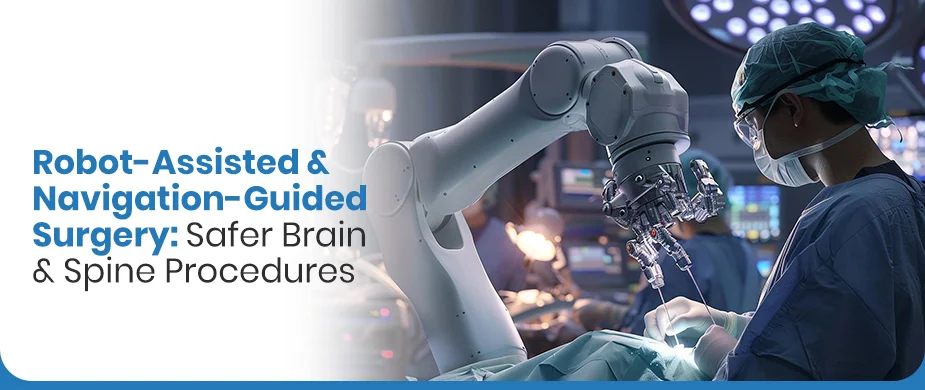
Call Us09958011121Robot-Assisted & Navigation-Guided Surgery: Safer Brain & Spine Procedures
One basic fact is evident to anyone who has ever suffered from a brain or spine issue: everything is impacted. Your confidence, your work, your sleep, and even your sense of control over your own body. Also, it's normal for your heart to fall a little when a doctor suggests "surgery."
Safety is crucial when it comes to brain and spine surgery. "Will the surgery be safe?" is one of the top concerns people have, regardless of whether they have a brain tumour, slipped disc, persistent back pain, or a complex neurological disorder. The fact that the brain and spinal cord are the most sensitive and vital parts of the human body, this anxiety is quite rational. Deciding on such issues is not simple. Your mobility, memory, and identity are all controlled by your brain and spine, making them extremely critical body parts.
Healthcare is now more focused on making these procedures safer, less invasive, and more reliable, seeing the criticality of brain and spinal functions for the body. Today, technology has brought us to a point where doctors don’t have to rely on sight and skill alone.
At IBS Hospital, our highly skilled neurologists are delivering high success rates in surgically managing critical brain and spine conditions using futuristic approaches, i.e., robot-assistance & navigation-guidance in neurosurgery.
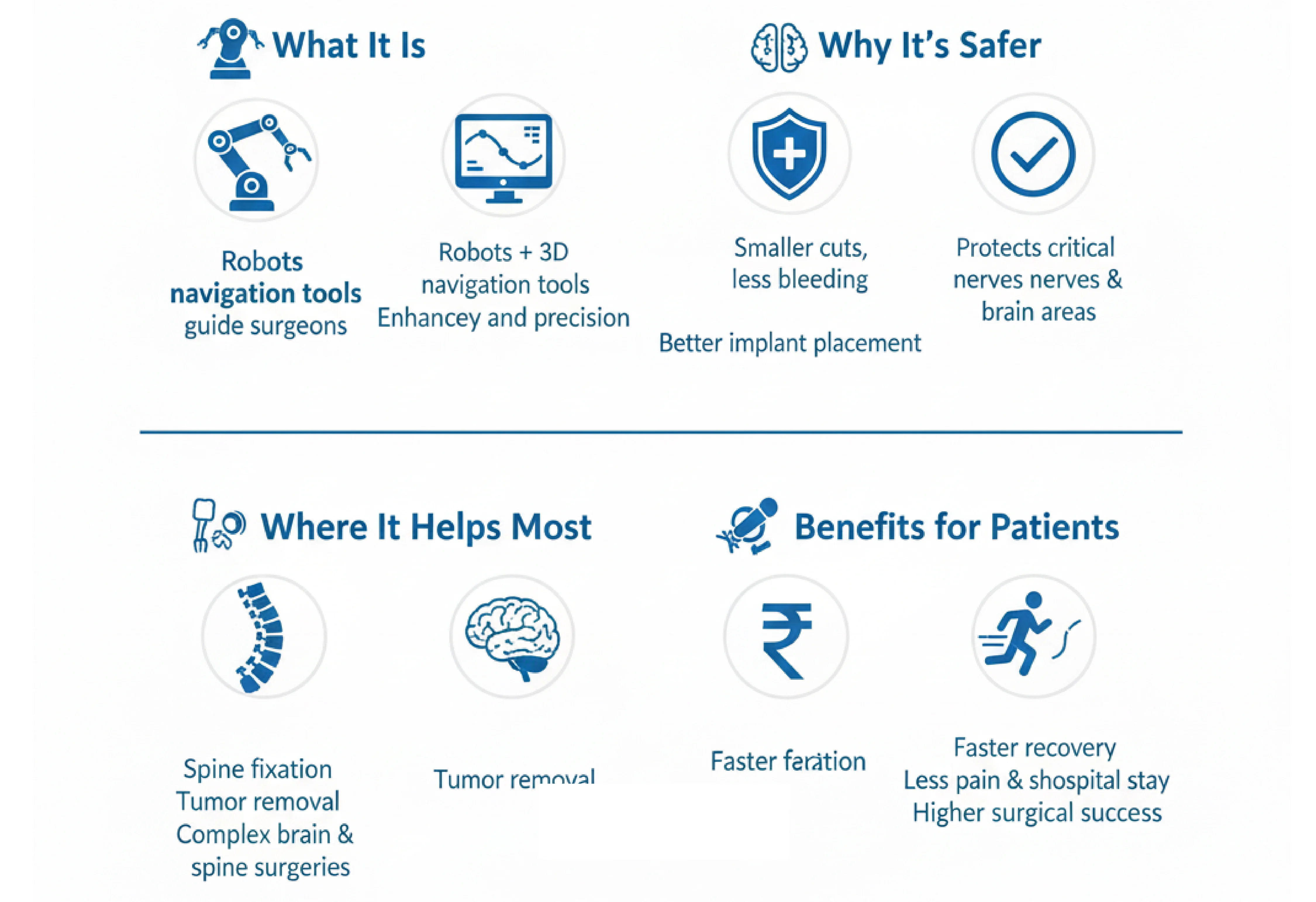
Significance of Robot-Assisted & Navigation-Guided Surgery in Safer Brain & Spine Procedures
The science behind robotic surgery is evolving every day for a broad spectrum of neurological surgeries. Advanced robotic technology integrated operating rooms make even microsurgical treatments possible. Robotic neurosurgery can provide significant advantages over conventional neurosurgeries. The small neurological structures and the need for precise neurosurgical techniques make the brain and spinal structures most suitable for the application of cutting-edge technology like robotic surgery.
This fine technology can provide appropriate equipment to critically support bony fusion in spine surgery. When robotic systems are compared with conventional freehand procedures, the majority of studies found that the accuracy was either superior or equivalent that too with minimal invasion. Such robotic neurosurgical systems also find great application in managing brain issues, including brain tumors and movement control disorders.
Many studies indicate that robotic neurosurgery can improve the precision as well as accuracy of neurosurgical procedures. The potential of surgical robots to enhance spinal instrumentation methods has led to this development in the neurosurgical discipline. It is also known to improve the surgical outcomes by minimising the risk of postsurgical tremors and other complications.
Which Brain & Spine Procedures Can Be Performed With Robot-Assistance & Navigation-Guidance?
The following are the robot-assisted and navigation-guided procedures for brain disorders:
| Procedure | What It Is / How It Helps |
| Deep Brain Stimulation (DBS) | To assist treatment of movement disorders, including Parkinson's disease, essential tremor, or dystonia, a device applies regulated electrical pulses to specific brain cells. |
| Stereo-Electroencephalography (SEEG) | It's mainly applied for the assessment of epilepsy. It aids in determining the precise area of the brain where seizures start. It helps in treatment planning, which may involve surgery or medications. |
| Stereotactic Biopsy | It's a guided method for locating and removing a small sample of brain tissue using precise instrumentation. It aids in identifying a disease's origin, type, or severity. |
| Ventricular Endoscopy | It’s a minimally invasive endoscopic approach for performing surgery inside the brain’s ventricles (fluid-filled spaces). It aids in cyst removal, relieving hydrocephalus, or creating CSF pathways. |
| Transnasal Endoscopy | The pituitary gland and base of the skull are accessed by passing a thin endoscope via the nasal cavity. This method allows for less invasive surgery for pituitary tumors and diseases of the skull base while eliminating the need for big incisions. |
The following are the navigation-guided and robot-assisted procedures for spine disorders:
| Procedure | What It Is / How It Helps |
| Epidural Spinal Cord Stimulation (SCS / Epidural Stimulation) | Electrodes are positioned close to the spinal cord to transmit electrical impulses during this minimally invasive treatment. It relieves chronic pain by altering nerve impulses and aids in the restoration of mobility in certain individuals with spinal cord injuries. When placing electrodes, robotic navigation increases precision and safety. |
| Robotic-Assisted Pedicle Screw Placement | During spine fusion procedures, pedicle screws are precisely inserted under the guidance of robots. This improves long-term spinal stability, decreases tissue damage, shortens surgery time, and increases precision. |
| Robotic Lumbar Fusion (TLIF/PLIF) | For transforaminal or posterior lumbar interbody fusion, robotic technology helps with implant placement and navigates the complex spinal framework. This improves implant placement accuracy, lowers blood loss, and speeds up healing. |
| Navigation-Guided Decompression (Laminectomy/Laminotomy) | Surgeons can safely remove bone or ligaments that compress the spinal nerve with the use of sophisticated 3D navigation. This leads to better results for conditions including herniated discs and spinal stenosis. |
| Robotic Cervical Spine Procedures | In the cervical spine, where structures are smaller and more fragile, robots assist with precise screw insertion and decompression. The robotic technology is used to treat cervical disc illness, trauma, and deformity repair. |
| Minimally Invasive Robotic Discectomy | By guiding the removal of a herniated disc fragment through a small incision, robotic navigation minimizes muscle injury and facilitates a quicker return to normal activities. |
| Robotic Spinal Deformity Correction (Scoliosis/Kyphosis) | During intricate deformity procedures, robots help ensure that the spine is precisely aligned. It results in fewer complications, less time-consuming surgery, and high surgical accuracy. |
| Navigation-Guided Vertebroplasty/Kyphoplasty | In osteoporosis-related spine fractures, real-time imaging and navigation direct the injection of bone cement into broken vertebrae, offering prompt pain relief and structural support. |
Conclusion
Even with all the robotic arms, 3D imaging, and real-time navigation, surgery is ultimately about trust. It is about handing over your fears, your hopes, and your future to a medical team. Robotic and navigation-guided surgery is not meant to remove the human touch—it enhances it. It gives surgeons the confidence to do their best work and gives patients the comfort of knowing that everything possible is being done to protect them.
The best neurologists are here to help you at IBS Hospitals, an advanced neurosurgery hospital in Delhi. For personalized care, book your consultation now!
FAQs
Q1: What is the success rate of robotic spine surgery?
A: The success rate of robotic spine surgeries varies depending on the type of surgery, the overall health of the patient, and the surgical method applied. The vast majority of these treatments are successful. For example, the success rate for robot-assisted screw insertion is between 91.5% and 94.4%.
Q2: Is robotic brain surgery expensive?
A: Yes, robotic brain surgery is often costly due to the high cost of robotic devices, specific training, and pre- and post-operative care. While expenses vary based on the procedure, facility, and location, they can be considerably higher than other surgical techniques.
Q3: Is robotic spine surgery painful?
A: It is common to have pain and soreness following surgery. However, most patients report less blood loss, postoperative discomfort, and complications than with standard surgery.
 By -Dr Aaksha Shukla |
December 17, 2025 | 9 Min Read
By -Dr Aaksha Shukla |
December 17, 2025 | 9 Min Read
Cervical Spondylotic Myelopathy: Symptoms, Diagnosis & Surgery
Advanced Neuro Rehabilitation for Cerebral Palsy & Brain Disorders
What Is Cerebral Palsy? Symptoms, Diagnosis & Treatment for Children
Febrile Seizures in Children: What Every Parent Should Know
Brain Aneurysm Treatment in Delhi NCR: Symptoms, Surgery & Recovery
Monsoon Migraine Triggers in 2026: Why Headaches Increase During the Rainy Season
Deep Brain Stimulation Surgery in Delhi for Parkinson’s Tremors
Spine Surgery in Delhi NCR: When is Surgery the Best Option?
Stroke Risk in Summer (2026): How Heat & Dehydration Affect the Brain
Minimally Invasive Brain Surgery: Benefits, Procedure & Recovery
Lower Back Pain: Causes, Symptoms & Non-Surgical Treatments
Slip Disc (Herniated Disc): Symptoms, Causes & Treatment Options
What Is Neuromodulation Therapy? Types, Benefits & How It Works
Headache Reasons: Causes of Left Side & Right Side Headache Explained
Home Remedies for Headache: 10 Natural Ways to Get Relief Fast
Parkinson’s Disease Treatment Hospital in India
Brain Stroke Treatment Hospital – Emergency Care
Stroke Paralysis Treatment Hospital – Advanced Neuro Care
Paralysis Treatment Hospital in India – Cost & Recovery
Brain Infection Symptoms, Causes, and When to Seek Emergency Care