
Book an Appointment
Call Us09958011121Epidural Stimulation After Spinal Cord Injury: Current Evidence, Potential Benefits and Limitations
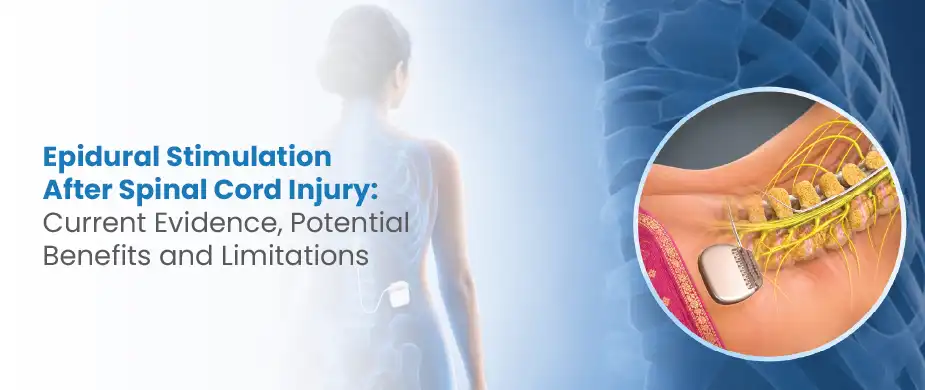
Epidural spinal cord stimulation is a technique that uses surgically implanted electrodes to deliver electrical stimulation near the spinal cord. It is being investigated as an approach to support motor function in some people with spinal cord injury, particularly when combined with specialised rehabilitation.
Early clinical studies have reported improvements in selected movements and functional activities in some participants. However, the evidence remains limited, and outcomes vary. Epidural stimulation is not a cure for spinal cord injury and is not suitable for everyone.
Read Also: Major Indications of Epidural Stimulation
What Is a Spinal Cord Injury?
The spinal cord carries signals between the brain and the body and plays an important role in movement, sensation and other functions. An injury can disrupt these signals, leading to changes in movement, sensation and bodily functions below the affected level.
The effects depend on the level and severity of the injury. A spinal cord injury described as ‘complete’ is classified according to a clinical assessment of sensory and motor function; it does not necessarily mean that every nerve connection across the injury has been physically severed.
The extent of any remaining neural connections cannot be determined from the term ‘complete’ alone. Assessment by a qualified specialist is important when considering treatment options.
Read Also: Types Of Spinal Cord Injury
What Is Epidural Stimulation?
Epidural stimulation involves placing electrodes in the epidural space near selected spinal cord regions. The electrodes are connected to a pulse generator that delivers programmed electrical stimulation.
In spinal cord injury research, stimulation is intended to influence spinal neural circuits involved in movement. This approach differs from conventional spinal cord stimulation used for certain chronic pain conditions.
The procedure requires specialist assessment and surgical implantation. Its use for restoring motor function after spinal cord injury remains an evolving area of clinical research.
Read Also: Spinal Cord Injuries Explained: Causes, Symptoms & How to Clear Your Mind
How Does Spinal Cord Stimulation Help Restore Movement?
Epidural stimulation may influence spinal neural circuits involved in movement. When combined with task-specific training, it may help some people with spinal cord injury perform selected movements or functional activities.
The response varies depending on the nature of the injury, the individual’s remaining neurological function, the stimulation protocol and the rehabilitation programme.
Rehabilitation is an important part of the approach being studied. Any movement practice must be adapted to the individual’s abilities and carried out with appropriate supervision and safety measures. Stimulation alone should not be presented as a way to restore walking.
Research-Backed Evidence
Research into epidural stimulation after spinal cord injury has reported encouraging findings, particularly when stimulation is combined with intensive rehabilitation.
Early studies published in 2018 described improvements in selected motor functions in small groups of people with chronic spinal cord injury. Subsequent research, including a 2022 study published in Nature Medicine, investigated targeted stimulation combined with rehabilitation in a small group of participants.
In a study published in The New England Journal of Medicine, four patients with chronic motor-complete paralysis underwent epidural stimulation and rehabilitation. Two with some preserved sensation regained the ability to walk with assistance, after 15 and 85 weeks of training. The other two could stand and take a few steps on a treadmill.
A separate report published by Scientific American described how Jared Chinnock, who had complete loss of movement and sensation below his injury, regained the ability to walk about 100 metres over ground with assistance after 43 weeks of training.
A study led by researchers from the Swiss Federal Institute of Technology in Lausanne (EPFL) and Lausanne University Hospital (CHUV) and published in Nature Medicine in 2022 showed how targeted epidural stimulation could help restore motor functions in patients with complete sensory-motor paralysis.
The study revolves around three men with complete paralysis, who underwent electrode array implantation over the lumbosacral spinal cord. Within a single day, they were able to stand, walk, cycle, swim and control the movement of the torso. After months of rehabilitation, they were able to integrate these abilities into day-to-day life. One of the participants who underwent the therapy for more than a year was able to stand for almost two hours at a stretch.
These studies provide important evidence for further research. However, their small sample sizes and specialised study settings limit the conclusions that can be drawn about outcomes for the wider spinal cord injury population.
Reported improvements should not be interpreted as evidence that every person with paralysis can regain standing or walking ability. Larger studies and further clinical evidence are needed to clarify who may benefit, the extent of potential benefits and the long-term outcomes.
Who Might Be a Candidate for Epidural Stimulation?
There is no single checklist that can determine whether a person is suitable for epidural stimulation after spinal cord injury. Potential eligibility depends on the individual’s neurological assessment, injury characteristics, general health, rehabilitation needs and the criteria used by the clinical programme or research study.
Specialist evaluation may include a review of the injury history, neurological function, medical stability, potential surgical risks and ability to participate in the proposed rehabilitation programme.
Meeting some of these criteria does not guarantee eligibility or a particular treatment outcome. Patients should discuss the current evidence, available alternatives and uncertainties with an appropriately qualified specialist.
Other Parts of Spinal Cord Injury Treatment That Still Matter
Epidural stimulation does not replace comprehensive spinal cord injury care. Depending on the individual’s needs, ongoing management may include bladder and bowel care, skin protection, pain management, prevention of complications, psychological support, mobility assistance and adaptations to the home environment.
These aspects of care remain important regardless of whether a person undergoes stimulation or participates in a rehabilitation programme.
Risks and Limitations
Epidural stimulation involves an invasive procedure and may carry risks, including infection, bleeding, complications related to anaesthesia, lead displacement or device malfunction. The procedure may also require follow-up programming, device maintenance or additional surgery.
The potential benefits and risks vary according to the individual and the treatment protocol. Anyone considering this approach should discuss the available evidence, alternatives, possible complications and long-term follow-up requirements with the treating specialist.
Conclusion
Epidural stimulation is an evolving area of research in spinal cord injury rehabilitation. Early studies have reported improvements in selected motor functions in some participants, particularly when stimulation is combined with specialised rehabilitation. However, the evidence remains limited, and outcomes cannot be guaranteed.
People living with spinal cord injury should discuss available rehabilitation options, potential risks and the current evidence with a qualified specialist. Treatment decisions should be based on an individual clinical assessment and realistic expectations.
FAQs
Q1. What is epidural stimulation for spinal cord injury?
A: Epidural stimulation is a technique in which electrodes are surgically placed in the epidural space near the spinal cord to deliver electrical stimulation. Its potential role in supporting motor function after spinal cord injury is being investigated.
Q2. Can spinal cord stimulation cure paralysis?
A: No. Epidural stimulation is not a cure for spinal cord injury or paralysis. Research suggests that selected individuals may improve certain motor functions when stimulation is combined with rehabilitation, but results vary and are not guaranteed.
Q3. Can a person with a complete spinal cord injury walk again with epidural stimulation?
A: Some small clinical studies have reported assisted walking or other motor improvements in selected participants with severe spinal cord injuries. These findings do not mean that everyone with a complete injury will regain walking ability. Suitability and potential outcomes require individual assessment.
Q4. Who may be considered for epidural stimulation?
A: Potential eligibility depends on the injury characteristics, neurological assessment, medical stability, surgical risks and the requirements of the clinical programme. A specialist must determine whether the approach is appropriate for an individual.
Q5. How long does it take to see results?
A: There is no established timeline that applies to everyone. Research studies have reported different outcomes over varying periods of stimulation and rehabilitation. Results depend on several factors, and the timelines reported in individual studies should not be treated as predictions for other patients.
Medical Disclaimer
This article is for general information and does not replace professional medical advice, diagnosis or treatment. Spinal cord injuries differ greatly from person to person, and treatment decisions should be made with a qualified neurologist or neurosurgeon who has examined you and reviewed your scans.
References
Rowald A, Komi S, Demesmaeker R, et al. Activity-dependent spinal cord neuromodulation rapidly restores trunk and leg motor functions after complete paralysis. Nature Medicine, 2022;28(2):260-271. https://doi.org/10.1038/s41591-021-01663-5
Walking again after paralysis: early study suggests stimulation could jolt spinal cord back to life. STAT News, 7 February 2022. https://www.statnews.com/2022/02/07/walking-again-after-paralysis-early-study-suggests-stimulation-could-jolt-spinal-cord-back-to-life/
Motor function restored in three men after complete paralysis from spinal cord injury. MDedge, 2022. https://mdedge.com/internalmedicine/article/251525/neurosurgery-trauma/motor-function-restored-three-men-after-complete
Thanks to Spinal Stimulation, Paralyzed Man Walks the Length of a Football Field. IEEE Spectrum. https://spectrum.ieee.org/thanks-to-spinal-stimulation-paralyzed-man-walks-the-length-of-a-football-field
Paralysed patients able to walk following epidural stimulation. The Daily Star (report on the 2018 NEJM and Nature Medicine studies). https://www.thedailystar.net/node/1646509
Mortality profile of patients with traumatic spinal injuries at a level I trauma care centre in India. PubMed Central. https://pmc.ncbi.nlm.nih.gov/articles/PMC4181158
Neyaz O, Kanaujia V, Yadav RK, et al. Epidemiology of Traumatic Spinal Cord Injury in the Himalayan Range and Sub-Himalayan Region. Annals of Rehabilitation Medicine, 2024;48(1):86-93. https://pmc.ncbi.nlm.nih.gov/articles/PMC10915302
 By -Dr Aaksha Shukla |
November 06, 2026 | 9 Min Read
Neuromodulation for Chronic Pain and Movement Disorders: Types, Uses and Risks
Post-Stroke Rehabilitation: Exercises and Therapies to Support Recovery
Cervical Spondylotic Myelopathy: Symptoms, Diagnosis & Surgery
Advanced Neuro Rehabilitation for Cerebral Palsy & Brain Disorders
What Is Cerebral Palsy? Symptoms, Diagnosis & Treatment for Children
Febrile Seizures in Children: What Every Parent Should Know
Brain Aneurysm Treatment in Delhi NCR: Symptoms, Surgery & Recovery
Monsoon Migraine Triggers in 2026: Why Headaches Increase During the Rainy Season
Deep Brain Stimulation Surgery in Delhi for Parkinson’s Tremors
Spine Surgery in Delhi NCR: When is Surgery the Best Option?
Stroke Risk in Summer (2026): How Heat & Dehydration Affect the Brain
Minimally Invasive Brain Surgery: Benefits, Procedure & Recovery
Lower Back Pain: Causes, Symptoms & Non-Surgical Treatments
Slip Disc (Herniated Disc): Symptoms, Causes & Treatment Options
What Is Neuromodulation Therapy? Types, Benefits & How It Works
Headache Reasons: Causes of Left Side & Right Side Headache Explained
Home Remedies for Headache: 10 Natural Ways to Get Relief Fast
Parkinson’s Disease Treatment Hospital in India