


Book an Appointment
Call Us09958011121Stroke Risk in Summer (2026): How Heat & Dehydration Affect the Brain
Stroke risk during summer (March to June) may increase because heat can lead to dehydration. This, in turn, thickens your blood, making clot formation more likely.
Research now shows that prolonged heat exposure can thicken blood, affect blood pressure, and increase inflammation. This can create the perfect conditions for an ischemic stroke, especially in older adults and people with hypertension, diabetes, or heart disease.
However, it is crucial to understand that hot weather doesn’t directly “cause” stroke, but it can create conditions where a stroke becomes more likely.
This guide explains:
- Why does hot weather increase the risk of stroke?
- How dehydration affects your brain
- Are stroke and heat stroke different?
- Early dehydration symptoms you should never ignore
- Who faces the highest risk
- How to protect yourself during a heat wave?
Let’s start with the biggest question that you might have in your mind.
Read Also: Stroke Prevention & Management: Key Strategies for Better Health
Does Hot Weather Really Increase Stroke Risk?
Yes.
Multiple studies, including recent climate-health research, show that extreme heat is associated with a higher risk of ischemic stroke.
Here Are the Biggest Reasons
- Dehydration
- Blood thickening
- Blood pressure fluctuations
- Heat stress on the cardiovascular system
- Increased inflammation and clotting activity
Summer heat acts like invisible stress on the body.
You may not notice it immediately, but internally your cardiovascular system is working much harder to maintain balance.
And the brain is one of the first organs affected when circulation becomes unstable.
Read Also: Guide to Stroke Prevention and Recovery
Let's Understand Why Stroke Risk Increases in Summer
When experts talk about stroke risk in summer, they are really talking about how your body reacts to heat stress.
Think of your blood system like a highway:
- At normal temperature, traffic flows smoothly
- But in extreme heat, dehydration makes the “traffic” thicker and slower
- This slowdown raises the chance of a “blockage accident” (blood clot)
And the blockage in the brain’s blood supply is what experts call an ischemic stroke.
Summer heat not only makes you sweat more but also quietly changes how your heart, blood vessels, and brain function together.
Read Also: Signs of a Stroke: When to Seek Emergency Neuro Care
Why Stroke Risk in Summer Increases: The 3 Main Mechanisms
The risk of stroke increases during summer because of the following three mechanisms:
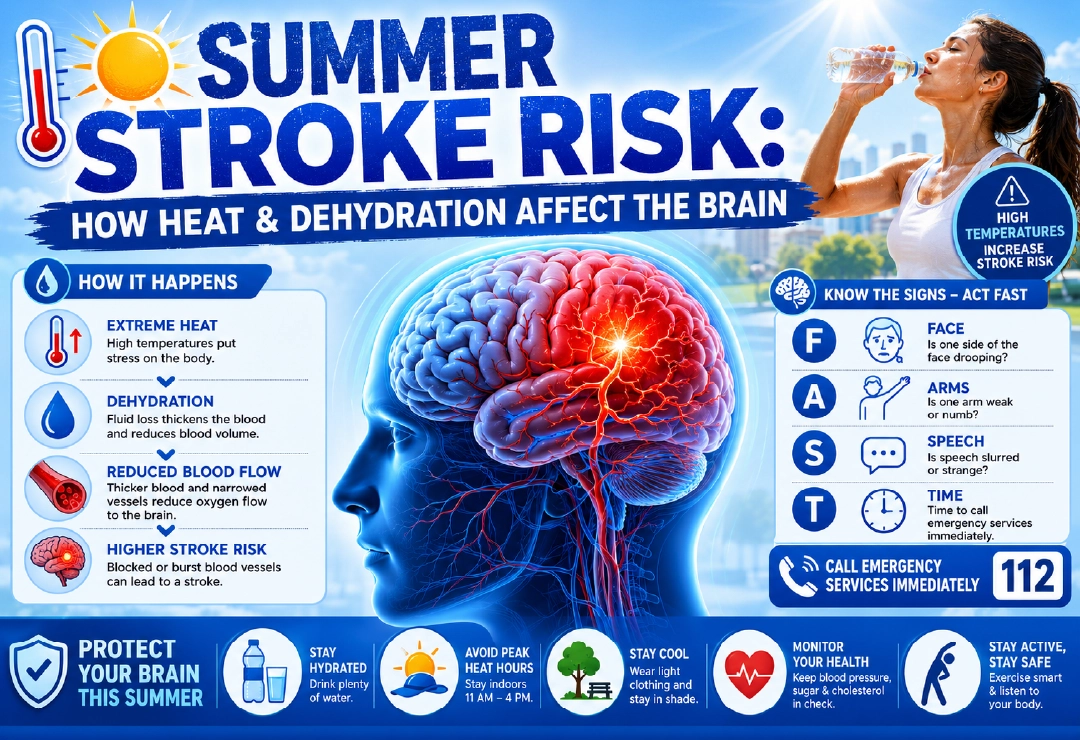
1. Dehydration Thickens the Blood
If you are wondering “how dehydration affects the brain," here is what happens:
When temperatures rise:
- Your body sweats more
- You lose fluids and electrolytes
- Blood volume decreases
- Blood becomes thicker and stickier
Imagine trying to drink juice through a straw versus trying to drink a milkshake.
That’s what dehydration does to blood flow.
Thicker blood moves slower and increases the chance of clot formation.
If a clot blocks an artery supplying the brain, it can trigger an ischemic stroke.
2. Heat Puts Extra Pressure on the Heart
Your body constantly tries to cool itself during summer.
To do this:
- Blood vessels expand
- Heart rate increases
- Blood pressure fluctuates
For healthy individuals, this may only cause fatigue.
But for someone with:
- Hypertension
- Diabetes
- Heart disease
- Previous stroke history
…it becomes dangerous.
The cardiovascular system starts operating under stress, similar to running an air conditioner at maximum power all day long. Eventually, systems become unstable.
3. Heat Increases Inflammation
Extreme heat can trigger inflammatory responses inside the body.
Research suggests high temperatures may:
- Increase inflammatory cytokines
- Disrupt clotting balance
- Raise oxidative stress levels
Think of inflammation like rust building inside pipes.
The more inflammation present, the easier it becomes for blood vessels to narrow or malfunction.
This is one reason stroke risk in summer becomes more serious during prolonged heatwaves.
Read Also: Signs of a Stroke: When to Seek Emergency Neuro Care
Dehydration Symptoms You Should Never Ignore
Do not wait until you feel “very thirsty.”
Your body usually starts dehydrating before thirst becomes obvious.
Common dehydration symptoms:
- Dry mouth
- Headache
- Dizziness
- Dark yellow urine
- Muscle cramps
- Fatigue
- Rapid heartbeat
- Confusion
In older adults, dehydration can appear differently:
- Sudden weakness
- Confusion
- Slurred speech
- Balance issues
Sometimes these symptoms overlap with stroke warning signs, which creates confusion during heatwaves.
That’s why you should know the main differences.
Read Also: Exploring the Best Treatments for Brain Stroke
Heat Stroke vs Stroke: What’s the Difference?
You might often mix these two conditions up because both are medical emergencies involving the brain.
But they are very different problems.
| Heat Stroke | Stroke |
| Caused by overheating | Caused by blocked or ruptured blood vessel in brain |
| Body temperature becomes dangerously high | Brain loses proper blood supply |
| Often linked to prolonged heat exposure | Often linked to clots or bleeding |
| Symptoms include hot skin, confusion, collapse | Symptoms include facial drooping, speech trouble, arm weakness |
The confusing part:
Both conditions can cause:
- Confusion
- Dizziness
- Difficulty speaking
- Loss of consciousness
That’s why both should be treated as a neuro emergency. Never try to “wait it out.”
Read Also: Stop a Stroke Before It Starts: Key Tips for Stroke Prevention
What Is a Neuro Emergency?
Neurological emergencies are health emergencies affecting the body's nervous system, including the brain, spinal cord, optic and olfactory nerves. That's why every minute matters because brain cells begin dying quickly when oxygen supply is interrupted.
Stroke Warning Signs (FAST method)
F — Face drooping
One side of the face looks uneven.
A — Arm weakness
One arm suddenly feels numb or weak.
S — Speech difficulty
Speech becomes slurred or confusing.
T — Time to call emergency services
Do not delay.
Think of the brain like a smartphone battery without charging.
The longer blood supply is interrupted, the faster the system shuts down.
Read Also: Stroke Paralysis Treatment Hospital – Advanced Neuro Care
Who is at Highest Risk for Stroke in Summer?
Not everyone faces equal danger during heatwaves.
Some groups are far more vulnerable.
Older Adults (65+)
Older adults:
- Sweat less efficiently
- Feel thirst less intensely
- Have weaker temperature regulation
This makes dehydration happen faster.
Research consistently shows higher stroke risk in summer among older populations.
People with Hypertension or Diabetes
Heat stress worsens:
- Blood pressure instability
- Circulation problems
- Blood sugar fluctuations
This combination increases clotting risk.
Outdoor Workers
Construction workers, farmers, delivery workers, athletes, and laborers spend long hours under direct heat exposure.
Physical exertion plus dehydration creates dangerous cardiovascular strain.
Urban Residents
Cities trap heat through:
- Concrete
- Traffic
- Reduced greenery
- Heat island effect
Urban heat exposure often remains high even during nighttime.
Read Also: The Importance of Timely Stroke Management and Rehabilitation
Why Heatwaves Are Becoming More Dangerous
Climate researchers now warn that:
- Heatwaves are lasting longer
- Temperatures are reaching higher extremes
- Nights are staying hotter
This matters because the body normally cools down at night.
Without recovery time, cardiovascular stress accumulates day after day.
Think of it like continuously revving a car engine without ever turning it off.
Eventually, systems begin failing.
Read Also: Understanding Ischemic Stroke
How to Reduce Stroke Risk in Summer
The good news is that prevention is often simple. Here are the five tips to keep in mind.
1. Hydrate Before You Feel Thirsty
Do not wait for thirst.
Drink water regularly throughout the day.
If sweating heavily:
- Use electrolyte solutions
- Eat water-rich foods
- Avoid excessive alcohol
Hydration keeps blood flowing normally.
2. Avoid Peak Heat Hours
The hottest period is usually:
- 10 AM to 4 PM
If possible:
- Stay indoors
- Use fans or air conditioning
- Reduce outdoor exertion
3. Dress Like Your Body Needs Cooling
Wear:
- Lightweight clothing
- Loose fabrics
- Light colors
Dark tight clothing traps heat and makes cooling harder.
4. Monitor Blood Pressure in Summer
People with hypertension should check blood pressure more frequently during heatwaves.
Heat can make readings unpredictable.
5. Never Ignore Sudden Neurological Symptoms
If someone develops:
- Slurred speech
- Sudden confusion
- Weakness
- Facial drooping
Seek immediate medical attention or contact a neuro emergency department without delay.
Can Young Healthy People Also Be at Risk?
Yes, although the risk is lower.
Young people can still experience the following:
- Severe dehydration
- Heat exhaustion
- Electrolyte imbalance
- Heat-triggered clotting problems
Especially during:
- Intense workouts
- Outdoor sports
- Long travel
- Heat exposure without hydration
Remember, no one is completely immune to heat stress.
Conclusion: Summer Heat Can be Harder on the Brain Than Most People Think
Most people think summer only affects comfort. But extreme heat changes how the cardiovascular system works.
It affects:
- Blood thickness
- Blood pressure
- Inflammation
- Clotting
- Brain circulation
That’s why stroke risk in summer is becoming a growing health concern worldwide. The dangerous part is how quietly it develops. Dehydration rarely feels dramatic at first.
It starts small:
- A headache
- Slight dizziness
- Fatigue
- Dry mouth
But internally, the body may already be struggling.
So this summer:
- Stay hydrated
- Learn stroke warning signs
- Protect vulnerable family members
Because preventing a stroke is always easier than recovering from one.
Are you looking for the best hospital for stroke treatment in Delhi?
You can contact the IBS Hospital at +91 9958011121.
Our Address: IBS Hospitals, 73 Ring Road, Lajpat Nagar III, New Delhi – 110024, India
Our Experts:
FAQs
Q1: Are strokes more common in the summer?
A: While stroke incidence varies by region and season, extreme heat and dehydration can increase the risk of ischemic stroke, particularly in vulnerable individuals.
Q2: What is the protocol for heat stroke?
A: Call emergency medical services immediately. If heat stroke is suspected, begin rapid cooling measures, preferably cold-water immersion when available, and continue cooling until medical help arrives.
 By -Dr Aaksha Shukla |
June 09, 2026 | 9 Min Read
By -Dr Aaksha Shukla |
June 09, 2026 | 9 Min Read
Cervical Spondylotic Myelopathy: Symptoms, Diagnosis & Surgery
Advanced Neuro Rehabilitation for Cerebral Palsy & Brain Disorders
What Is Cerebral Palsy? Symptoms, Diagnosis & Treatment for Children
Febrile Seizures in Children: What Every Parent Should Know
Brain Aneurysm Treatment in Delhi NCR: Symptoms, Surgery & Recovery
Monsoon Migraine Triggers in 2026: Why Headaches Increase During the Rainy Season
Deep Brain Stimulation Surgery in Delhi for Parkinson’s Tremors
Spine Surgery in Delhi NCR: When is Surgery the Best Option?
Minimally Invasive Brain Surgery: Benefits, Procedure & Recovery
Lower Back Pain: Causes, Symptoms & Non-Surgical Treatments
Slip Disc (Herniated Disc): Symptoms, Causes & Treatment Options
What Is Neuromodulation Therapy? Types, Benefits & How It Works
Headache Reasons: Causes of Left Side & Right Side Headache Explained
Home Remedies for Headache: 10 Natural Ways to Get Relief Fast
Parkinson’s Disease Treatment Hospital in India
Brain Stroke Treatment Hospital – Emergency Care
Stroke Paralysis Treatment Hospital – Advanced Neuro Care
Paralysis Treatment Hospital in India – Cost & Recovery
Brain Infection Symptoms, Causes, and When to Seek Emergency Care