


Book an Appointment
Call Us09958011121Febrile Seizures in Children: What Every Parent Should Know
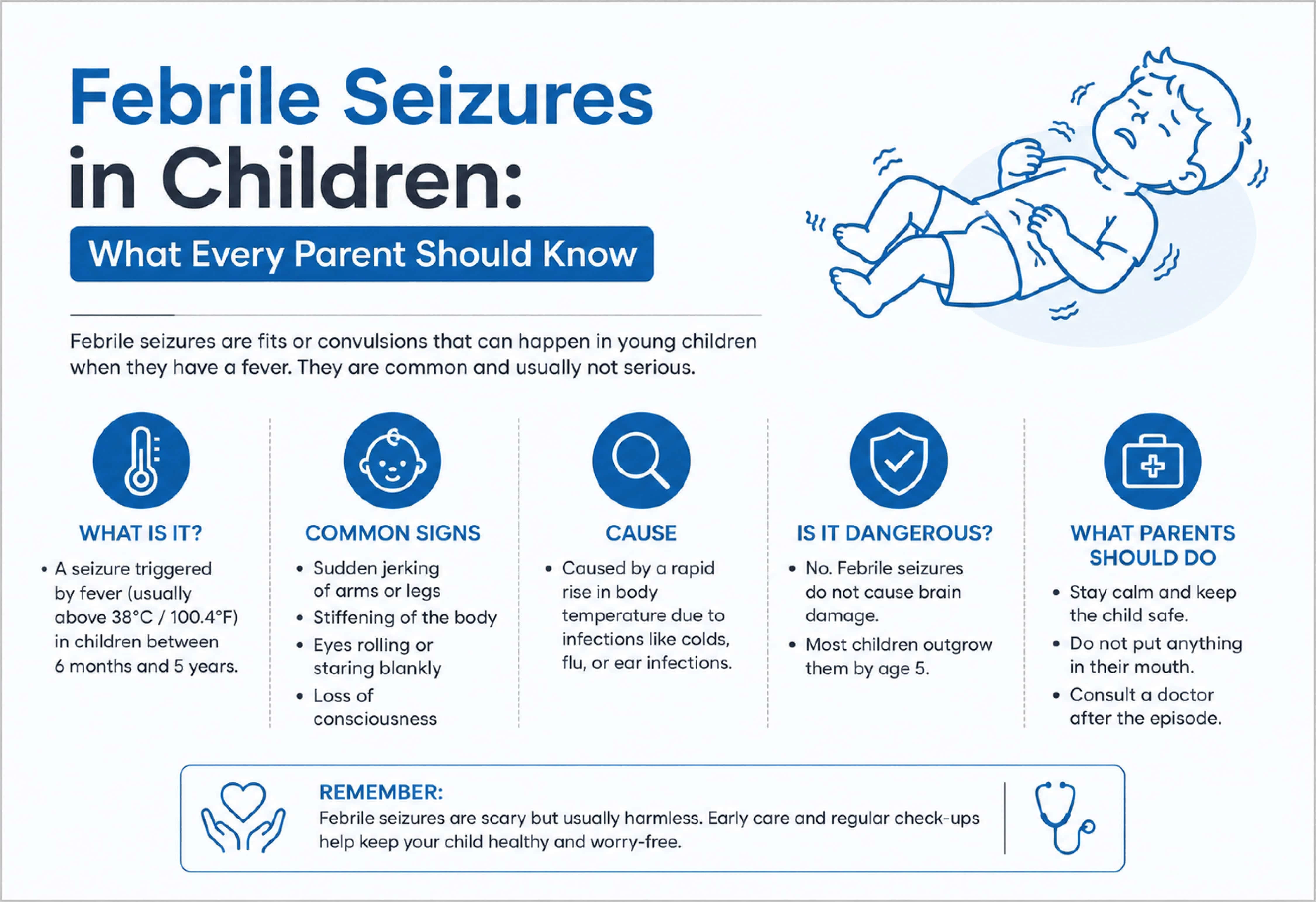
Febrile seizures are seizures associated with fever that usually occur in children between 6 months and 5 years of age, without evidence of a brain infection or another neurological cause. It is usually brief and stops on its own. It typically does not cause lasting health problems or epilepsy. Knowing what to do during a febrile seizure in children and how to respond to it is important. Getting medical care is essential to determine the cause of the fever and rule out other conditions.
Febrile seizures affect approximately 2%–5% of children between 6 months and 5 years of age, making them one of the most common childhood neurological conditions.
Read Also: Epilepsy Treatment in Delhi - Causes, Symptoms & Diagnosis
What Are Febrile Seizures?
Febrile seizures are convulsions that happen in children with a fever. They are triggered by a rise in body temperature to 38°C (100.4°F) or higher. In many children, the seizure is triggered by the rapid rise in body temperature rather than the exact temperature itself. Febrile seizures are not caused by an infection, head injury, or other medical condition that affects the brain. According to the American Academy of Paediatrics (AAP), febrile seizures are among the most common neurological events in early childhood.
A febrile seizure in children may happen when a child has a fever for the first time. It can also happen when the child has a fever that comes back after being gone for a while. Although they can be frightening for parents and caregivers, febrile seizures rarely cause serious health problems.
Read Also: Stop a Stroke Before It Starts: Key Tips for Stroke Prevention
What Causes Febrile Seizures?
The cause of febrile seizures is unknown. Researchers believe that they are triggered by a combination of genetic and environmental factors. The young child's developing brain is more susceptible to seizures during a fever.
Common causes of fever in children that can lead to febrile seizures include:
- Viruses such as influenza, roseola, and adenovirus
- Ear infections
- Upper respiratory tract infections
- Bacterial infections
- Fever due to some vaccines. Although the risk is small, the benefits of vaccination far outweigh the risks
According to the Centers for Disease Control and Prevention (CDC), febrile convulsions after vaccination are rare.
Read Also: Aphasia: Understanding Its Symptoms, Types, Causes, and Treatments
What Are the Symptoms of Febrile Seizures?
The symptoms of febrile seizure in children may include:
- Loss of consciousness
- Rhythmic jerking or shaking of the arms and legs
- Stiffening of the arms and legs
- Rolling of the eyes
- Unresponsiveness or loss of awareness
- Confusion or sleepiness after the seizure
Simple febrile convulsions in children are usually brief, lasting less than five minutes. They also stop on their own without treatment.
Read Also: Types of Dementia and Treatment Options in Delhi
Types of Febrile Seizures
Simple Febrile Seizures
Simple febrile seizures are the most common type of febrile convulsions. They have the following characteristics:
- Last for less than 15 minutes
- Whole-body movements
- Only one seizure in 24 hours
- Usually have a good outcome
Complex Febrile Seizures
A febrile seizure in children is considered complex if it:
- Lasts longer than 15 minutes
- Happens more than once in 24 hours
- Only affects one side of the body
Children with complex febrile convulsions may need further testing and febrile seizure treatment.
Read Also: Depression Treatment in Delhi: Types, Symptoms & Cause
What Should Parents Do During a Febrile Seizure?
If your child has febrile convulsions, it is important to stay calm and take the following steps:
- Place the child immediately on their side on a firm surface. Stay with the child until the seizure ends.
- Remove any objects that could hurt the child
- Loosen any tight clothing around the child’s neck
- Do not put anything in the child’s mouth
- Do not try to stop the shaking
- Time the seizure
- Call for emergency medical help if the seizure lasts longer than five minutes, the child has difficulty breathing, or the child is not fully alert after the seizure
According to the National Institute of Neurological Disorders and Stroke (NINDS), it is important not to put anything in the child’s mouth during a seizure. This can cause injury.
How Are Febrile Seizures Diagnosed?
Febrile convulsions are diagnosed based on the child’s symptoms, medical history, and physical examination. Other tests that may be done include:
- Exam to determine the cause of the fever
- Blood or urine tests if needed
- Lumbar puncture if meningitis is suspected
- EEG or brain imaging (CT or MRI) is rarely needed and is only recommended in selected cases where another neurological condition is suspected.
According to the AAP, brain scans are usually not needed for simple febrile seizures.
Febrile Seizure Treatment
The febrile seizure treatment for febrile convulsions depends on the cause and severity of the seizure. The main goal is to treat the underlying cause of the fever and prevent further seizures.
Treatment may include:
- Medications to reduce fever
- Fluids to prevent dehydration
- Treatment of any bacterial infections that may be present
- Observation until the child has fully recovered
If the febrile convulsions are prolonged, emergency medications may be needed in the hospital. Long-term anti-seizure medications are generally not recommended after simple febrile seizures because the risks usually outweigh the potential benefits.
Can Febrile Seizures Come Back?
Yes, febrile convulsions can happen more than once. In fact, about one-third of children who have them will have another seizure. The chance of recurrence is higher if:
- The child was under 18 months old when they had their first seizure
- There is a family history of febrile convulsions
- The first febrile seizure occurred before 18 months of age.
- The fever was low when the seizure happened
Despite this, most children who have febrile convulsions do not have any long-term health problems.
Can Febrile Seizures Be Prevented?
There is no sure way to prevent febrile seizures. Fever-reducing medicines improve comfort but do not reliably prevent febrile seizures. Parents can also take steps to prevent infections that can cause fever. This includes:
- Getting recommended childhood vaccines
- Washing hands often
- Seeking medical care for any infections
- Making sure the child drinks plenty of fluids when they are sick
When Should You Seek Medical Care for Febrile Seizures?
Parents should seek medical care for febrile convulsions if:
- The seizure lasts longer than five minutes
- The child has trouble breathing
- The seizure affects only one side of the body
- The child has another seizure within 24 hours
- The child has a stiff neck, vomiting, or a rash
- The child is under six months old and has a fever with a seizure
Prompt medical evaluation is important to rule out other conditions that may require treatment.
Conclusion
Most febrile seizures are brief, do not cause lasting health problems, and stop on their own. Knowing what to do during a febrile seizure in children and how to respond to it is important. Getting medical care is also essential to determine the cause of the fever and rule out other conditions. Appropriate febrile seizure treatment for febrile convulsions focuses on making the child comfortable and determining the cause of the fever. Most febrile seizures stop on their own within a few minutes. Treatment mainly focuses on identifying and managing the cause of the fever rather than preventing every seizure.
Talk to a Paediatric Specialist Today
Concerned about febrile convulsions or recurring fever-related seizures? Schedule an appointment with an experienced paediatric specialist to identify the underlying cause and receive personalized care and febrile seizure treatment for your child.
FAQs
Q1: Are febrile seizures dangerous?
A: Most febrile seizures are not dangerous and do not cause lasting health problems. However, every child’s first seizure should be evaluated by a healthcare professional to determine the cause of the fever.
Q2: Can a child develop epilepsy after febrile seizures?
A: The majority of children do not develop epilepsy after febrile convulsions. The risk is low, although it may be slightly higher in children with complex seizures and other neurological conditions.
Q3: Should I give fever medicine to my child to prevent another seizure?
A: Fever medicine helps make a child more comfortable but does not prevent febrile seizures. It is important to follow the recommended dosage instructions. Always use the correct dose based on your child's age and weight, and seek medical advice if you are unsure.
Q4: When should I call an ambulance for a febrile seizure?
A: Call for emergency medical help if the seizure lasts longer than five minutes, the child has difficulty breathing, the child is not fully alert after the seizure, or the child has another seizure soon after.
Q5: Can children recover completely from febrile seizures?
A: Yes, most children recover completely from febrile convulsions. They do not have any learning disabilities, developmental delays, or other long-term health problems.
 By -Dr Aaksha Shukla |
July 30, 2026 | 9 Min Read
By -Dr Aaksha Shukla |
July 30, 2026 | 9 Min Read
Cervical Spondylotic Myelopathy: Symptoms, Diagnosis & Surgery
Advanced Neuro Rehabilitation for Cerebral Palsy & Brain Disorders
What Is Cerebral Palsy? Symptoms, Diagnosis & Treatment for Children
Brain Aneurysm Treatment in Delhi NCR: Symptoms, Surgery & Recovery
Monsoon Migraine Triggers in 2026: Why Headaches Increase During the Rainy Season
Deep Brain Stimulation Surgery in Delhi for Parkinson’s Tremors
Spine Surgery in Delhi NCR: When is Surgery the Best Option?
Stroke Risk in Summer (2026): How Heat & Dehydration Affect the Brain
Minimally Invasive Brain Surgery: Benefits, Procedure & Recovery
Lower Back Pain: Causes, Symptoms & Non-Surgical Treatments
Slip Disc (Herniated Disc): Symptoms, Causes & Treatment Options
What Is Neuromodulation Therapy? Types, Benefits & How It Works
Headache Reasons: Causes of Left Side & Right Side Headache Explained
Home Remedies for Headache: 10 Natural Ways to Get Relief Fast
Parkinson’s Disease Treatment Hospital in India
Brain Stroke Treatment Hospital – Emergency Care
Stroke Paralysis Treatment Hospital – Advanced Neuro Care
Paralysis Treatment Hospital in India – Cost & Recovery
Brain Infection Symptoms, Causes, and When to Seek Emergency Care