


Book an Appointment
Call Us09958011121Spine Surgery in Delhi NCR: When is Surgery the Best Option?
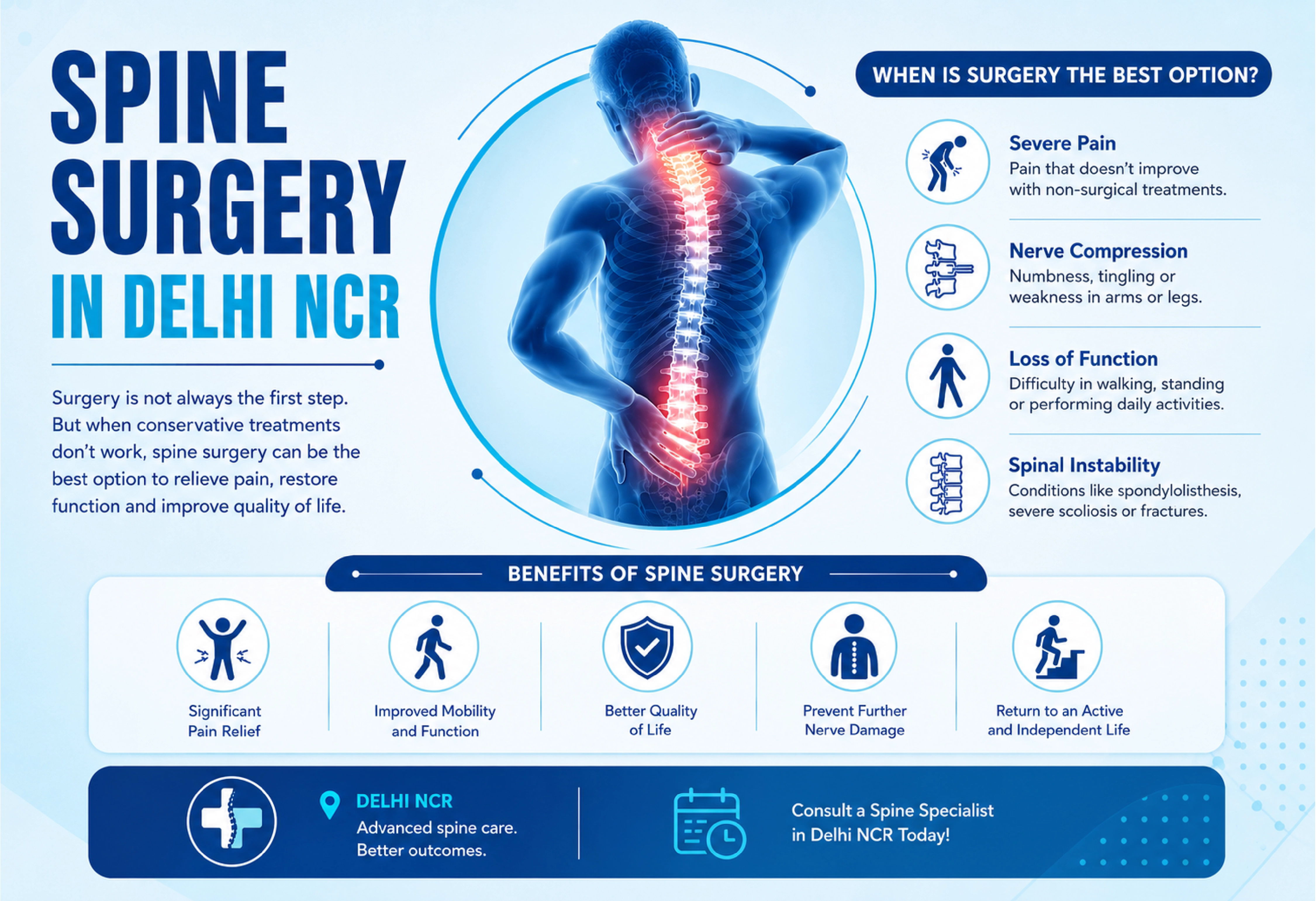
Most spine-related problems and back pain do not always require surgery. But when conditions like nerve compression, ruptured discs, spinal instability, or progressive weakness begin affecting your quality of life, your doctor may recommend spine surgery after careful assessment.
Today, spine surgery in Delhi NCR has become far more advanced than you imagine. Modern techniques such as minimally invasive spine surgery and robotic-assisted procedures enable faster recovery, smaller cuts, less pain, and better precision compared to traditional open surgery.
Read this guide to know:
- exactly when surgery becomes necessary
- which conditions may require spine surgery
- what treatment options are available in Delhi NCR
Read Also: A Closer Look at Types of Spine Surgery
When Do You Actually Need Spine Surgery?
Let’s clear one myth first.
Not every case of back pain needs surgery.
In fact, most spine conditions improve with conservative treatment such as
- Physiotherapy
- Pain medications
- Lifestyle changes
- Rest and posture correction
- Spinal injections
- Nerve root blocks
The best spine specialist in Delhi usually recommends surgery only after non-surgical treatments fail.
| Condition | Can It Improve Without Surgery? |
| Muscle strain | Usually yes |
| Mild slipped disc | Often yes |
| Early sciatica | Frequently improves |
| Degenerative disc disease | Many cases managed conservatively |
| Mild spinal stenosis | Sometimes manageable without surgery |
However, some situations may require immediate medical attention. Hence, consult a spine specialist in Delhi if you are experiencing back/spine pain accompanied by symptoms such as sudden loss of bladder or bowel control, significant leg weakness, or numbness in the groin/saddle area.
Read Also: Spine Surgery: Who Can Benefit from It
5 Signs You Should See a Spine Specialist Immediately
Certain symptoms are “red flags.” Do not ignore them to avoid permanent nerve damage.
Emergency Symptoms
| Symptom | Why It Matters |
| Loss of bladder or bowel control | Possible cauda equina syndrome |
| Sudden leg weakness | Severe nerve compression |
| Numbness around thighs or buttocks | Spinal emergency |
| Difficulty walking | Progressive neurological issue |
| Severe pain with weakness | May require urgent surgery |
Read Also: Innovative Spine Surgery Techniques At IBS hospital
What Spine Conditions Require Surgery?
Here are the 4 common spine conditions that may need surgery:
1. Slipped Disc (Herniated Disc)
A slipped disc is one of the most common reasons that may require spine surgery.
Think of your spinal disc like a soft cushion between two bones. When it bulges or ruptures, it can press against nearby nerves.
This may cause:
- Lower back pain
- Sciatica
- Leg numbness
- Burning sensation
- Weakness in legs
Most slipped disc surgery cases are avoided through physiotherapy and medication. But surgery becomes necessary when:
- Pain lasts beyond 6–12 weeks
- Weakness increases
- Walking becomes difficult
- Conservative treatment fails
Common Surgical Option:
- Microdiscectomy
- Endoscopic slipped disc surgery
Read Also: Spinal Cord Injury: Causes, Symptoms, and Treatment Options
2. Spinal Stenosis
Spinal stenosis means narrowing of the spinal canal.
Imagine traffic stuck inside a narrow tunnel. Similarly, nerves get compressed inside the spine.
Common symptoms include:
- Leg pain while walking
- Tingling
- Weakness
- Difficulty standing for long periods
Surgery is usually considered when:
- Daily activities become difficult
- Physiotherapy stops helping
- Nerve compression worsens
Common Procedures:
- Laminectomy
- Minimally invasive decompression surgery
Read Also: Robot-Assisted & Navigation-Guided Surgery: Safer Brain & Spine Procedures
3. Spondylolisthesis
This condition happens when one vertebra slips over another.
Low-grade slips may improve without surgery, but advanced instability often needs spinal fusion.
| Grade | Surgery Need |
| Grade I | Usually conservative |
| Grade II | Depends on symptoms |
| Grade III | Often surgical |
| Grade IV | Usually requires surgery |
4. Spinal Fractures
Spinal fractures may occur due to:
- Osteoporosis
- Trauma
- Falls
- Accidents
Some fractures heal naturally. Others require stabilization procedures.
Common Procedures:
- Kyphoplasty
- Vertebroplasty
These minimally invasive spine surgery techniques stabilize the vertebra using special cement.
What is Minimally Invasive Spine Surgery?
Many people still imagine spine surgery as a large cut with months of bed rest.
That is no longer true for many individuals.
Minimally invasive spine surgery uses:
- Tiny incisions
- Specialized cameras
- Small surgical instruments
- Less muscle damage
It’s similar to repairing wiring through a small access panel instead of breaking an entire wall.
Benefits of Minimally Invasive Spine Surgery
| Benefit | Why Patients Prefer It |
| Smaller incisions | Less scarring |
| Less blood loss | Safer recovery |
| Reduced pain | Faster mobility |
| Shorter hospital stay | Sometimes same-day discharge |
| Faster recovery | Return to work sooner |
Many Delhi hospitals like IBS Hospital now offer advanced minimally invasive spine surgery with excellent outcomes.
Types of Spine Surgery Available in Delhi NCR
Here are the main types:
Decompression Surgeries
These surgeries remove pressure from nerves.
| Procedure | Purpose |
| Laminectomy | Removes bone pressure |
| Discectomy | Removes damaged disc |
| Foraminotomy | Widens nerve passage |
| Nucleoplasty | Shrinks herniated disc |
Stabilization Surgeries
These surgeries stabilize the spine.
| Procedure | Purpose |
| Spinal Fusion | Joins vertebrae |
| Cervical Disc Replacement | Preserves neck movement |
| Instrumentation Surgery | Adds screws/rods for support |
Is It Safe to Go for Spine Surgery?
Modern spine surgery has improved significantly due to:
- Better imaging
- Navigation systems
- Robotic precision
- Advanced anesthesia
- Minimally invasive techniques
Many procedures now have high success rates when performed on the right candidate.
But success also depends on:
- Correct diagnosis
- Experienced spine specialist
- Patient health condition
- Post-surgery rehabilitation
Recovery After Spine Surgery
Recovery depends on the type of surgery.
Here’s a realistic timeline:
| Surgery Type | Approximate Recovery Timeline |
| Endoscopic discectomy | Few days to weeks |
| Microdiscectomy | 2–6 weeks |
| Minimally invasive fusion | Several months |
| Traditional open fusion | Longer recovery |
Most patients start walking within 24 hours after surgery.
However, recovery is not just about healing cuts. The spine itself needs time to stabilize and regain strength.
Your doctor may recommend physiotherapy after surgery for faster recovery.
How to Choose the Right Spine Specialist in Delhi
Choosing the right spine specialist is just as important as choosing surgery itself.
Look for these 5 points:
- Experience in minimally invasive spine surgery
- High surgery volume
- Advanced hospital infrastructure
- Rehabilitation support
- Transparent discussion about risks and benefits
Most experienced surgeons first explore conservative treatment before recommending surgery.
Why Delhi NCR Has Become a Major Spine Surgery Hub
Delhi NCR has emerged as one of India’s leading destinations for spine surgery because of the following:
- Advanced robotic technology
- Experienced spine specialists
- International-standard hospitals
- Availability of minimally invasive procedures
- Lower costs compared to many countries
Hospitals across Delhi NCR now offer the following:
- Robotic spine surgery
- Endoscopic spine procedures
- Computer-guided navigation
- Advanced rehabilitation programs
When Should You Finally Consider Surgery?
Here’s the simplest answer.
You should seriously consider spine surgery if:
- Pain is affecting daily life
- Weakness is progressing
- You cannot walk comfortably
- Conservative treatment failed after weeks/months
- MRI shows severe nerve compression
- Bladder or bowel symptoms appear
Surgery is not the first step. But delaying necessary surgery for too long can sometimes worsen nerve damage permanently. That’s why early evaluation from a qualified spine specialist is important.
Conclusion
Your spine is like the central wiring system of your body. Small problems may heal naturally, but severe compression or instability should not be ignored.
If your back pain keeps returning, if leg weakness is developing, or if a slipped disc is affecting your quality of life, consult a spine specialist early instead of waiting for the condition to worsen.
Sometimes rest and physiotherapy may help. But when surgery becomes necessary, choosing the right treatment at the right time can completely transform your mobility, comfort, and quality of life.
Best Spine Care Hospital in Delhi: IBS Hospital
Rated 4.5/5 based on 1,213 Google reviews, IBS Hospital is a trusted spine care hospital in New Delhi offering advanced diagnosis and treatment for a wide range of spinal disorders.
Our experienced spine specialists treat conditions such as slipped disc (disc prolapse), cervical and lumbar spine disorders, scoliosis, spinal instability, and spinal tumors through a personalized approach that combines conservative treatments with advanced minimally invasive spine surgery techniques.
From physiotherapy and pain management to complex spine procedures, our focus is on helping patients regain mobility, reduce pain, and improve quality of life with safe and evidence-based spine care.
You can contact the IBS Hospital at +91 9958011121.
Our Address: IBS Hospitals, 73 Ring Road, Lajpat Nagar III, New Delhi – 110024, India
Our Team of Senior Neurosurgeons
- Dr. Sachin Kandhari, 20 years of experience
- Dr. Dewaker Sharma, more than 20 years of in-depth experience
- Dr. Vikas Gupta, more than 22 years of in-depth experience
- Dr. Anup Gogoi, over 16 years of extensive experience
Explore Our Patient Stories
- Mr. Amer Shukur Mohammed from Iraq was suffering from a prolapsed lumbar disc.
- Witness the extraordinary journey of Mr. KM Agarwal, a 60-year-old whose life changed dramatically following a paralyzing horseback riding accident.
 By -Dr Aaksha Shukla |
June 09, 2026 | 9 Min Read
By -Dr Aaksha Shukla |
June 09, 2026 | 9 Min Read
Cervical Spondylotic Myelopathy: Symptoms, Diagnosis & Surgery
Advanced Neuro Rehabilitation for Cerebral Palsy & Brain Disorders
What Is Cerebral Palsy? Symptoms, Diagnosis & Treatment for Children
Febrile Seizures in Children: What Every Parent Should Know
Brain Aneurysm Treatment in Delhi NCR: Symptoms, Surgery & Recovery
Monsoon Migraine Triggers in 2026: Why Headaches Increase During the Rainy Season
Deep Brain Stimulation Surgery in Delhi for Parkinson’s Tremors
Stroke Risk in Summer (2026): How Heat & Dehydration Affect the Brain
Minimally Invasive Brain Surgery: Benefits, Procedure & Recovery
Lower Back Pain: Causes, Symptoms & Non-Surgical Treatments
Slip Disc (Herniated Disc): Symptoms, Causes & Treatment Options
What Is Neuromodulation Therapy? Types, Benefits & How It Works
Headache Reasons: Causes of Left Side & Right Side Headache Explained
Home Remedies for Headache: 10 Natural Ways to Get Relief Fast
Parkinson’s Disease Treatment Hospital in India
Brain Stroke Treatment Hospital – Emergency Care
Stroke Paralysis Treatment Hospital – Advanced Neuro Care
Paralysis Treatment Hospital in India – Cost & Recovery
Brain Infection Symptoms, Causes, and When to Seek Emergency Care